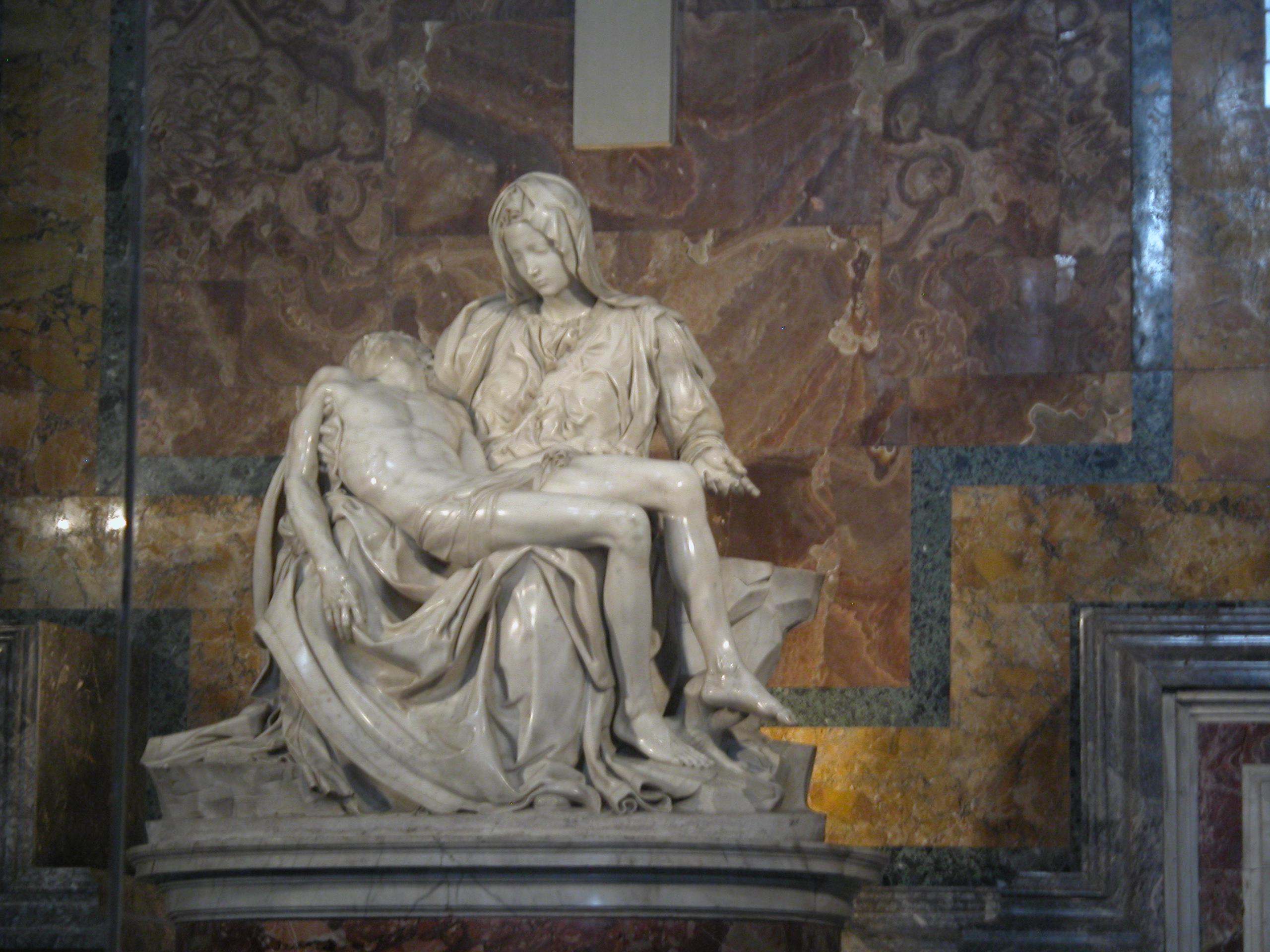
The famous sculpture, the Pieta by Michelangelo, is recognized worldwide. How can we not feel the emotional anguish of Jesus’ mother when we witness her bearing the weight of her beloved son in her arms? And how can any parent who has lost a child by any means not identify with our Holy Mother?
Pieta, meaning pity or compassion in Italian, dates to the Latin word for piety. Pietas refer to art that depicts the Virgin Mary cradling the body of Jesus Christ after his crucifixion.
The following is an excerpt on Pietas from one of my best-selling books, Grieving with Mary. Finding Comfort and Healing in Devotion to the Mother of God.
*
Throughout history, Marian art reflected the times as well as society’s current relationship with the Mother of God. Artistic representations of Mary vary with the ethnicity of the artist, the current perception of Mary, fashion trends, and the Church’s latest decree. Mary’s portrayals include an innocent young woman, mother of the infant child Jesus, and royal queen. She’s appeared common and regal. Her skin tones and features reflect people of various cultures, including Caucasian, Asian, Native American, East Indian, and African.
Fine art may take six months to a year or more to complete. Although only a fraction of the time one takes to grieve, this is a tremendous investment on the part of the artist. Yet foremost in the hearts of so many artists is the need to be close to Mary that century after century they have used their time and talent to honor her through their art. Through their chosen medium, they speak to and pray with Mary, and by doing so, they offer opportunities for admirers of their work to connect with her as well.
An evolution of thought is seen by the type of art produced through the ages. When the Council of Ephesus in the year 431 declared Mary the Theotokos—the Mother of God—representations of mother and child increased in popularity. Around the year 600, the Eastern Church designated August 15 as the Feast of the Dormition, also known as the Feast of the Assumption. Artists then portrayed Mary falling asleep, often in the presence of saints with Jesus ready to take her to heaven.
In the ancient city of Byzantium, which was later known as Constantinople and then Istanbul, Mary was regally depicted. This portrayal signified her power as greater than that of the rulers. European royalty followed by ordering artists to portray them in the popular Marian images to divert reverence from her to them.
During the 1300s and early 1400s, Mary’s regal image shifted to the loving and sorrowful mother due to the number of children who died in the plague. The greatest cause of heartache for any parent, or expectant parent, is their children’s suffering, illness, dangerous behavior, or death. Parents expect to see their children live healthy and happy lives long beyond them.
When a child dies at birth or during childhood, not only does the family lose a cherished family member, it also loses part of its innocence and purity. Future joys that parents may have hoped to experience with the child are no longer possible. In addition, the parents experience a type of death themselves as part of their legacy dies with the child. Their roles and definitions of themselves as parents are forever changed.
This pain was expressed in medieval Marian art. Mothers sympathized with Mary’s love for her child and her mourning over Jesus’ pain and death. They knew that Mary understood their own suffering. She could identify with their intense grief, and they identified with hers. For this reason, pietas—representations of the sorrowful mother with Jesus after the crucifixion—which were popular from at least the eleventh century, became even more so.
Michelangelo’s sculpture is the most famous Pieta. It also is the most frequently viewed work of devotional art in the world. Showcased behind bulletproof glass in St. Peter’s Basilica in the Vatican, the magnificent sculpture draws countless admirers each year. Completed in 1498 when Michaelangelo was only twenty-four years old, the Pieta masterfully reveals the full humanity of the divine Jesus as well as the magnitude of Mary’s love for her son and her great sorrow over his death.
In the mid-1500s, the Council of Trent forbade images representing false doctrines. Paintings that depicted Mary in ways that were not specifically known to be biblically founded were removed from the churches. Because Mary is only directly referred to in a handful of Scriptural passages, devotional art could only depict particular events.
Accepted topics included the Annunciation (see Luke 1:26-38), Visitation (see Luke 1:39-56), Nativity (see Luke 2:1-7), the Flight into Egypt (see Matthew 2:13-15), standing at the foot of the cross (see Luke 19:25-27), and her presence in the upper room for the Pentecost (see Acts 1:12-2:4).
*
*For more information on grieving a loss and how praying with Mary, the Mother of God, may ease that sorrow, see Grieving with Mary. You may also be interested in The Rosary Prayer by Prayer, Fatima at 100. Fatima Today, and Young in the Spirit. All of these titles are available on ACTA Publications’ website.)
**Photo taken by Mary K Doyle, St. Peter’s Basilica, Vatican City, 2006
©Mary K. Doyle, 2026


Talk to me. I’m curious about your thoughts and comments.