
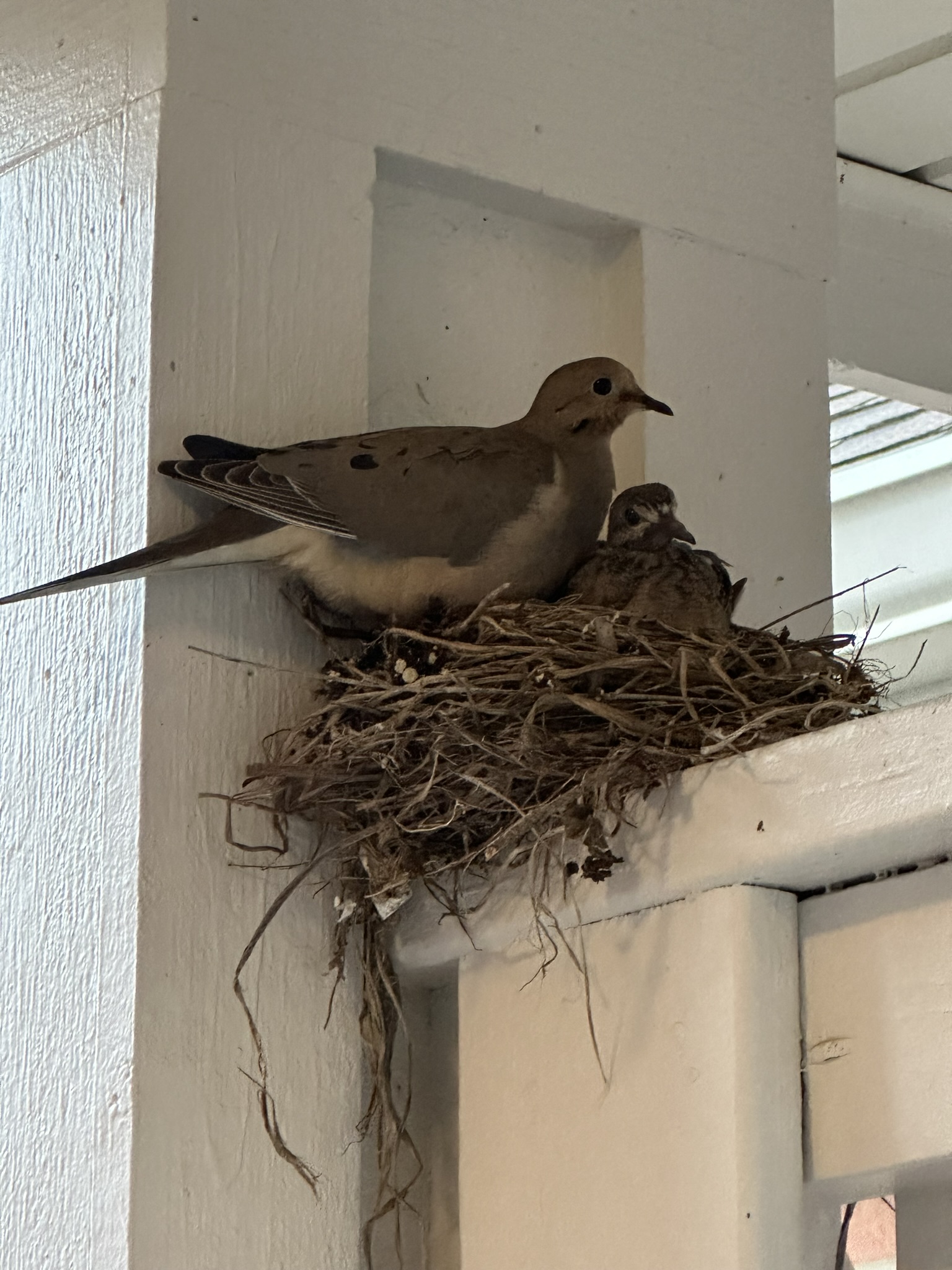
Mamma Mourning Dove has returned for another spring delivery of babies. She nests on the ledge between my neighbor’s and my front door patiently awaiting the arrival of her new babies.
One year, my neighbor and I wanted to take down the nest before Mamma Dove laid her eggs because of the weeks of droppings that would accumulate on our front steps. But it didn’t matter how often we tried to deter the dove. Within an hour, she would have another nest fully built.
We learned to let Little Mamma build her nest and wait to clean up after she completed her yearly obligation to produce and send out offspring. She has a mission, and who were we to stop her? Besides, she does not mind us coming in and out of our front doors. In fact, she is quite attentive when I ask her how she is doing.
This spring, Mamma laid two eggs. Both babies have grown into strong, healthy squabs and will soon leave the nest. They likely will stay in the area eating from my feeders or below it. Doves can eat 12-20 percent of their body weight each day storing their tasty treats in their esophagus, which is called the crop.
These birds are social beings. They fly in tight formations, one after another. There is a specific order of dominance in this flight pattern with the strongest male at the lead.
Doves are the most abundant game bird in North America. They are also the most hunted. More than 20 million are killed each year. However, no worries about eliminating the species. It is estimated that there are around 350 million doves on our continent.
For more information on doves, see Cornell Lab.
**Photos by Mary K. Doyle
***Do you love nature? Take a look at my newest book, Tranquility. Transformation. Transcendence. The full-color book features 72 poems and 72 photos inspired by the findings in public gardens.
©2024, Mary K. Doyle
 Midwest Mary
Talk to me. I’m curious about your thoughts and comments.