
One of my favorite activities is to walk in the midst of nature. Pathways along rivers, lakes, and ponds offer abundant opportunities to spot flora and fauna. Treasures are to be found everywhere we look–deer, woodpeckers, turtles, moss, fungi.
One “treasure” I hadn’t considered are snakes. On a recent walk, a six-year-old nature enthusiast pointed out several snakes along a pond and stream I’d otherwise be oblivious to. I’ll be looking more closely under the rocks, tree stumps, and in the waterways on these types of walks from now on.
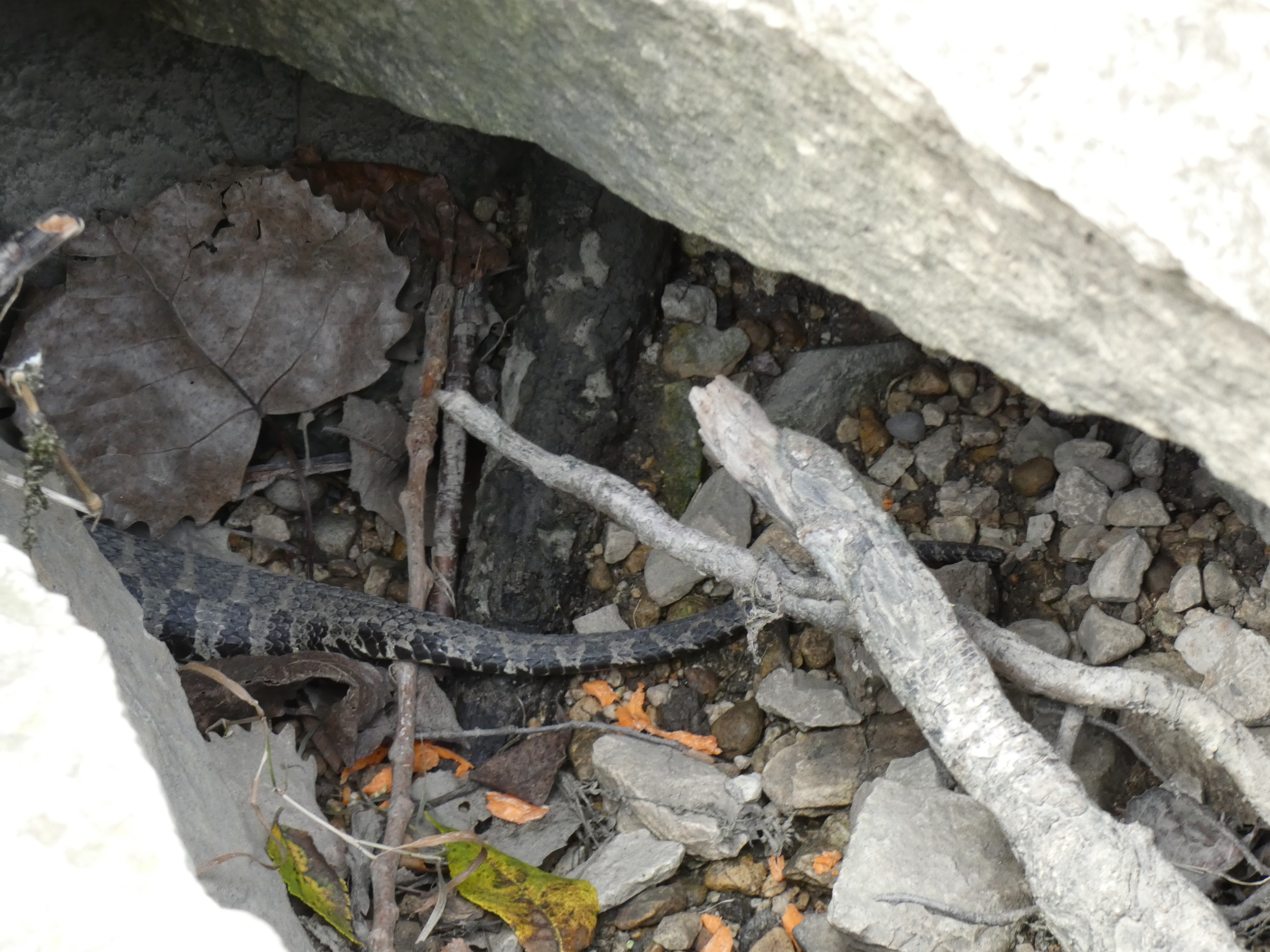
Approximately 40 species of snakes slither through Illinois. Most snakes have no interest in harming humans–until humans start poking them, which in my opinion, is fair. Only four species are venomous: Eastern Massasauga Rattlesnake, found in the northern part of Illinois; and Copperhead, Cottonmouth, and Timber Rattlesnake, found in the Southern end of the state.
Our state’s venomous snake species are pit vipers and belong to the Viperdae family. Their distinguishable characteristics include their elliptical (vertical shaped) pupils, their large sensory heat-sensing pits on both sides of their heads between each eye and nostril, their broad, triangular shaped heads, and a single row of scales under the tail.

I honestly don’t know what type of snake I encountered on that walk. If you do, please tell us!
***Take care of yourself so you can better care for your loved ones. Suggestions on how to do that can be found in my book, Inspired Caregiving. Amazon has it at a bargain price right now.

Nature feeds our bodies and our spirits. It provides us with beauty, interest, creativity, food, and medicine. So, when we look for solutions, why not look to nature first?
Such natural generosity is evident in the sticky, sweet syrup of honey. Amazingly, honey contains antibacterial, antiviral, anti-inflammatory, and antifungal properties. When purchasing honey, look for a rich, dark color as the darker the honey the greater the antioxidant properties. Honey also has vitamins, minerals, and amino acids, which vary according to the nectar source.

Countless claims contest to the healing effects of honey. Here are a few:
- It’s said to release serotonin thereby increasing one’s mood. That serotonin converts to melatonin aiding in sleep.
- Local honey is thought to assist in relieving seasonal allergies.
- A spoonful of honey coats and soothes a sore throat and suppresses a cough.
- Some believe in the effectiveness of honey dressings on minor burns and scrapes.
- A solution of honey and warm water can be applied to the scalp to relieve itching and flaking.
- In addition to drinking lots of water, honey may assist the liver in processing alcohol oxidation and ridding toxins from over-consumption of alcohol.
- Raw, unprocessed honey may be applied as a mask to reduce the inflammation and redness associated with acne.
- Honey is said to reduce irritation after an insect bit.
- Honey may improve cholesterol and triglyceride levels.
- It may even lower blood pressure.

According to WebMd, Manuka honey, which is produced only in New Zealand by bees that pollinate the Manuka bush, is considered particularly beneficial. The flavor is slightly more earthy than regular honey but this type of honey offers much more in the way of nutritional and antibacterial properties. In addition, it contains methylglyoxal (MGO) and hydrogen peroxide. It may be particularly beneficial for bacteria-related digestive disorders and wound healing. Bandages containing Manuka are available over-the-counter.
Research shows Manuka honey can stimulate tissue regeneration, reduce inflammation, and decrease swelling. Studies also show it to be helpful in treating gingivitis.
As with most things in life, with all the positives, there are a few factors to consider. Manuka honey is definitely pricier than regular honey. And all honey contains calories, although, most people believe it is sweeter than white sugar and so can be used in lower quantities. Also, some people can be allergic to the pollen and/or digestive enzymes from the bees.
Most importantly, the American Academy of Pediatrics cautions parents not to introduce honey to children before the age of 1 year of age. Children’s underdeveloped immune systems make them vulnerable to botulism, a serious form of food poisoning. Incorporating honey in cooked food should be safe for children.
*See more at WebMD.
*Pray for world peace. We all will be better for it. The Rosary Prayer by Prayer, Grieving with Mary, Fatima at 100. Fatima Today.
*Thank you to all who have read my books, and especially, to those who have read and reviewed them on Amazon.
©2022, Mary K. Doyle
 Midwest Mary
Talk to me. I’m curious about your thoughts and comments.